Thursday, February 12, 2015

Productive Stupidity

When I was a child, there were whole classes of people who possessed an almost-Drudical power and eminence: parents, doctors, the clergy, teachers, scientists, civic leaders. Part of their power rested in the fact that everything about their lives was a mystery. The idea that my 4th grade teacher, for example, might have a life outside of the classroom, or that Mr. Justice So-and-So might vacation on Cape Cod with his spouse, quite simply never entered my mind. And even though one would occasionally hear the phrase, "Just remember, we all put our trousers on one leg at a time," no one ever seemed really to believe it.


Today, by contrast, the young know almost everything about their parents' lives, the clergy are all-too-often in the news for various indiscretions, doctors are just another cog in the machine of the medical-bureaucratic system, teachers are more and more likely to "share" stories of their off-duty experiences with their students. Even the world's royal families have not been able to preserve the shroud of mystery that had kept their power unassailable for centuries.  The exact disposition of the trousers of many of these is rarely left to the imagination.


And, all too often, our authorities have let us down. This, of course, is nothing new. With the centenary of the 1914-1918 War, the image of the British generals leading hundreds of thousands of men to their deaths at the Somme, Ypres, Verdun, the Marne is before us. The generals planned it, the clergy blessed it, the king told us that every death was noble, the press refused to report it, the politicians funded it; and after 1918, when the men in the trenches began to tell their stories, the underpinnings of the whole structures of authority started to crumble.


In his wonderful book No Sense of Place (Oxford University Press, 1986), Joshua Meyrowitz talks about this process, and about about the role of the media in pulling off the "invisibility cloak" that had allowed authority to maintain its mystique, and hence its power over us. Meyrowitz, professor of communications at the University of New Hampshire, argues that mass media have broken down the established concepts of roles, hierarchies, and identities by showing us the intimate details of the lives of authority figures, and by closing the social distance between us and them. (The number of people who said they would vote for George W. Bush because "he seemed like a guy I could sit down and have a beer with." is just one example of this.)


All of this has been brought to mind in the past week or so by the furore surrounding the vaccination of children for measles. In the past, physicians and scientists simply told us that we should be vaccinated -- for polio, for measles, for rubella and whooping cough -- and we happily complied, largely without hesitation. Many of us had seen the terrors of polio, my mother had had whooping cough as a child, her father had had smallpox. We had as a part our common memory the devastation of infectious disease, and the high-priests of science had finally conjured up our salvation from it. We were grateful. We lined up for injections. It didn't matter that we didn't understand how they worked or why they worked. The "experts," the "authorities" told us that they would work, and we believed them.


But the world has turned, and the words of one anti-vaccination mother are shared by many: "You just have to follow your own heart when it comes to medical decision-making.” In other words, we may not understand science, but we know what we like. Or perhaps because we don't understand science, and don't trust the authority of scientists, we are left with "what we like" as the ground of our decision-making. Part of our retreat from scientific authority is that, as the chemist-poet Carl Djerassi (who died at the end of January at the age of 92) says: "The talk is heavy and the words are long." And so in matters related to science, whether the science of infectious disease, or climate change, or Ebola, or the risk of the earth being hit by a meteorite, we are left to the panderers of alarm (and the anecdotes of the alarmists) to tell us what to think and believe.


Perhaps part of it is that we have begun to feel with real intensity the disjuncture between the waning authority of those who engage in scientific pursuit on the one hand, the their immense power over our lives on the other.  Carl Djerassi provides a good example. Most people, it is safe to say, had never heard of him, although among his peers he was honored and respected, not least for his work over such a wide range of scientific disciplines: from marine biology to artificial intelligence, from the structure of steroids to pest control.

But Djerassi's most lasting impact on the lives of ordinary human beings was through his groundbreaking work on oral contraceptives, which gave women control of fertility and family planning, and re-ordered the balance of power between men and women. Our lives and the life of our planet has been immeasurably and irrevocably changed by the work of this one man working in his lab on things that can only be described by "heavy talk" and "long words." (Anyone with allergies or hay fever should also be grateful to Djerassi, whose work led to the development of the first commercially-available antihistamines.)


I despair the generalized scientific illiteracy of my fellow citizens. But it is not very surprising: there is simply too much to know, and things move too fast, and even the simplest explanations, precisely because they are simple, get it wrong. The "authorities" can't explain it to us, and even if they could the underpinnings of their authority are unsound, and our trust is weakened. The group to which we belong, whether we are a "crunchy Mom," an  evangelical Christian, a vegan, or a GMO activist, has far more power to interpret the world of science than those who are actually doing the work, "the experts." Our group latches on to anecdotes about MMR vaccines and autism, or outlier studies about "the myth of climate change," or the Biblical view of the age of the earth, and we know what to think. It has become simple.

Do I have a solution to all of this? Do I even have a suggestion? Not really. I do know that as an immune-compromised person, I am really frightened that don't-know anything-about-science-but-know-what-they-like anti-vaccination people are putting me and lots of others at risk. I do know that I am really frightened by people who are not concerned with climate change because the Apocalypse is coming and God will rapture all the righteous off the planet before anything bad happens. I do know that I am really frightened by politicians who think that women can't get pregnant if they are the victims of "legitimate rape," and that LGBT people can be "made straight" with the right kind of psychological counseling.

But while the human consequences of these kinds of beliefs are indeed frightening, even more frightening is the certainty of those who hold them. No argument, no amount of new information, no evidence that their hypotheses are off-base, will shake their conviction.

In The Importance of Stupidity in Scientific Research (Journal of Cell Science, 2008)Martin A. Schwartz, Professor of Medicine and Biomedical Engineering at Yale, talks about the role of ignorance and failure in the scientific pursuit. He says:

“The crucial lesson was that the scope of things I didn’t know wasn’t merely vast; it was, for all practical purposes, infinite. That realization, instead of being discouraging, was liberating. If our ignorance is infinite, the only possible course of action is to muddle through as best we can.”


The anti-science crowd will surely use this as a further nail in the coffin for scientific authority. "They don't know what they are doing: they're just blundering around." But Schwartz is talking about a particular kind of stupidity here, a "productive stupidity," a joy in getting things wrong because you know you are on the way to getting it right, a willingness to wade into the unknown without fear.

That indeed may be the best way of approaching the work of science. But it seems to me that it is also the best way of approaching life in general. And if we could just understand that, if we could just embrace the power of "productive stupidity" (as opposed to just plain old implacable stupidity), we might not be quite so dangerous as a species.


Monday, January 12, 2015

Waiting for the Barbarians

Someone once said that "poetry is the best defense against prose." And at the beginning of a year when we will hear, read, and produce more prose than is probably good for us, I thought we should begin with a poem. The Greek poet C.F. Cavafy (1863-1933) published a fairly large body of work, but the only poem of his that I know is Waiting for the Barbarians (1904). So, with the a new Congressional year upon us, and with news of acts of terror and mayhem across the world in mind, I will reproduce here in full:

             Waiting for the Barbarians

What are we waiting for, assembled in the forum?
            The barbarians are due here today.
Why isn’t anything happening in the senate?
Why do the senators sit there without legislating?
            Because the barbarians are coming today.
            What laws can the senators make now?
            Once the barbarians are here, they’ll do the legislating.
Why did our emperor get up so early,
and why is he sitting at the city’s main gate
on his throne, in state, wearing the crown?
            Because the barbarians are coming today
            and the emperor is waiting to receive their leader.
            He has even prepared a scroll to give him,
            replete with titles, with imposing names.
Why have our two consuls and praetors come out today
wearing their embroidered, their scarlet togas?
Why have they put on bracelets with so many amethysts,
and rings sparkling with magnificent emeralds?
Why are they carrying elegant canes
beautifully worked in silver and gold?
            Because the barbarians are coming today
            and things like that dazzle the barbarians.
Why don’t our distinguished orators come forward as usual
to make their speeches, say what they have to say?
            Because the barbarians are coming today
            and they’re bored by rhetoric and public speaking.
Why this sudden restlessness, this confusion?
(How serious people’s faces have become.)
Why are the streets and squares emptying so rapidly,
everyone going home so lost in thought?
            Because night has fallen and the barbarians have not come.
            And some who have just returned from the border say
            there are no barbarians any longer.
And now, what’s going to happen to us without barbarians?
They were, those people, a kind of solution.

In Cavafy's poem the barbarians never do come, leaving the politicos with nothing to do and no one to blame.

But in our case the barbarians have come, and they have been very, very busy. And this week has been marked by a series of particularly barbarous public acts. For me, the most difficult image to come to grips with was of the little 10-year old Nigerian girl, strapped up to an explosive device and sent by the men of Boko Haram into a local marketplace. There they detonated the bomb by remote control, killing her and 19 others. And in this first half of the first month of the new year, there have already been too many stories like this. I feel fear and despair when I hear them. Worse still, I feel my heart slowly turning to stone.

Fear and despair and hard-heartedness are, of course, the barbarians' stock-in-trade. And in some sense they have already won: we are afraid so we don't travel and we put bigger locks on our doors, we despair so we give up on peacemaking, our hearts are hardened so we torture and we build walls between ourselves and The Other and we buy lots and lots and lots of guns.


But it is the beginning of a new year. And there is still something about the beginning of the new year that primes us for fresh starts and a future of possibilities that we intend to grasp with both hands. And we are deeply cheered, deeply moved, by the sight of millions of people filling the streets of Paris with placards: Je suis Charlie, Je suis, Ahmed, Je suis Police.


We are cheered by the growing trend in Pakistan, where for the first time young people are willing to post calls for the end of Taliban and, even in the face of the threat of reprisal, are brave enough to give their names and show their faces on social media. We are cheered by stories of medical personnel from the West traveling to West Africa to treat the victims of ebola at great personal risk. We are are cheered by acts of courage, we are cheered by visions of hope, we are cheered by signs of faith in the future.


Yes, fear and despair and hard-heartedness are the stock-in-trade of the barbarians. But they are also, sadly, the storck-in-trade of the merchants, the sellers of bombs and guns and locks and walls. So I imagine that what used to be called the 'military-industrial complex' are intensly worried about these outbreaks of hope. I imagine they are asking, like the people in the Cavafy poem, "what's going to happen to us without the barbarians?" It is a hard combination to fight, the combination of those who incite our fear and those who profit from our fear. These days, it's hard to know which sort of barbarian is the more dangerous.

But it is the beginning of a new year. And we are primed to make a fresh start. But we know today, when the barbarians have indeed come, that the hardest New Year's Resolution we may ever have to make is a commitment to hope.


Tuesday, December 23, 2014

How to say a year . . .

To sum up a year is an impossible thing. This year has brought us joyous joys and heart-rending sorrows and the  host of ordinary, nondescript days that have stitched them together.

So I will let the words of others capture the spirit of this year for us. And because it is poetry most of all that has the power to compress and crystallize and and illuminate human experience, these words come in the form of three poems.

We lost our last two old dogs this year, in quick succession as the nights grew longer at the tail end of the year. From his volume Aimless Love (Random House, 2013) former poet-laureate Billy Collins offers us "A Dog on its Master:"

As young as I look,
I am growing older faster than he,
seven to one
is the ratio they tend to say.

Whatever the number,
I will pass him one day
and take the lead
the way I do on our walks in the woods.

And if this ever manages
to cross his mind,
it would be the sweetest
shadow I have ever cast on snow or grass.

(to hear Collins read this poem, go to https://www.youtube.com/watch?v=iVc10aF7_gw


And I always remember the words of Martin Luther, incised on the tombstone for a dog named Spritz in a tiny German graveyard.

"Fear not, Little Dog, for in Heaven you shall have a tail of gold"

We also celebrated our 20th wedding anniversary, with good food, glorious performances of Shakespeare's comedies of mis-aligned lovers, Love's Labours Lost and Much Ado about Nothing, and time spent on 'the remembrance of things past.'

Young poets Sarah Kay and Phil Kay (both b. 1988) are with others co-founders of Project V.O.I.C.E, which "uses spoken word poetry to entertain, educate, and inspire," motivating young people to find their own voices and to share the stories of their lives. (See the Project V.O.I.C.E. website at http://www.projectvoice.co/project-voice-our-program and Sarah Kay's TED talk at http://www.ted.com/talks/sarah_kay_how_many_lives_can_you_live)

Their own poetry gets something of the serendipity of love, its fragility and its strength. This, the last stanzas of  Sarah and Phil Kay's long poem "When Love Arrives"


Love is not who you were expecting, love is not who you can predict.
Maybe love is in New York City, already asleep;
You are in California, Australia, wide awake.
Maybe love is always in the wrong time zone.
Maybe love is not ready for you.
Maybe you are not ready for love.
Maybe love just isn’t the marrying type.
Maybe the next time you see love is twenty years after the divorce, love is older now, but just as beautiful as you remembered.
Maybe love is only there for a month.
Maybe love is there for every firework, every birthday party, every hospital visit.
Maybe love stays -- maybe love can’t.
Maybe love shouldn’t.

Love arrives exactly when love is supposed to,
And love leaves exactly when love must.
When love arrives, say, “Welcome. Make yourself comfortable.”
If love leaves, ask her to leave the door open behind her.
Turn off the music, listen to the quiet, whisper,
“Thank you for stopping by.”


In October Vermont poet-laureate and Pulitzer-Prize winning poet Galway Kinnell died (1927-2014). His work combines a love of nature, the destructiveness of cruelty and indifference, and a spare unwavering gaze toward the deepest human relationships. Our lives this year have been filled with books and authors and words old and new, and from his 1990 collection When One Has Lived A Long Time Alone, Kinnell's poem "Oatmeal" captures some of the delight we have found in our long-time literary companions:


I eat oatmeal for breakfast.
I make it on the hot plate and put skimmed milk on it.
I eat it alone.
I am aware it is not good to eat oatmeal alone.
Its consistency is such that is better for your mental health
if somebody eats it with you.
That is why I often think up an imaginary companion to have
breakfast with.
Possibly it is even worse to eat oatmeal with an imaginary
companion. 
Nevertheless, yesterday morning, I ate my oatmeal -- porridge,
as he called it -- with John Keats.
Keats said I was absolutely right to invite him: due to its glutinous
texture, gluey lumpishness, hint of slime, and unsual willingness
to disintigrate, oatmeal must never be eaten alone.
He said that in his opinion, however, it is perfectly OK to eat
it with an imaginary companion,
and that he himself had,enjoyed memorable porridges with Edmund
Spenser and John Milton.
Even if eating oatmeal with an imaginary companion is not as
wholesome as Keats claims, still, you can learn something from it.
Yesterday morning, for instance, Keats told me about writing the
"Ode to a Nightingale."
He had a heck of a time finishing it -- those were his words -- "Oi 'ad
a 'eck of a toime," he said, more or less, speaking through his
porridge.
He wrote it quickly, on scraps of paper, which he then stuck in his
pocket,
but when he got home he couldn't figure out the order of the stanzas,
and he and a friend spread the papers on a table, and they
made some sense of them, but he isn't sure to this day if they got it right.
An entire stanza may have slipped into the lining of his jacket through
a hole in his pocket.
He still wonders about the occasional sense of drift between stanzas,
and the way here and there a line will go into the configuration of a
Moslem at prayer, then raise itself up and peer about, and then lay
itself down slightly off the mark, causing the poem to move
forward with a reckless, shining wobble.
He said someone told him that later in life Wordsworth heard about
the scraps of paper on the table, and tried shuffling some stanzas
of his own, but only made matters worse.
I would not have known any of this but for my reluctance to eat oatmeal
alone.
When breakfast was over, John recited "To Autumn."
He recited it slowly, with much feeling, and he articulated the words
lovingly, and his odd accent sounded sweet.
He didn't offer the story of writing "To Autumn," I doubt if there
is much of one.
But he did say the sight of a just-harvested oat field go thim started
on it, and two of the lines, "For Summer has o'er-brimmed their
clammy cells" and "Thou watchest the last oozings hours by hours," came
to him while eating oatmeal alone.
I can see him -- drawing a spoon through the stuff, gazing into the glimmering
furrows, muttering -- and it occurs to me:.
maybe there is no sublime; only the shining of the amnion's tatters.
For supper tonight I am going to have a baked potato left over from lunch.
I am aware that a leftover baked potato is damp, slippery, and
simultaneously gummy and crumbly,
and therefore I'm going to invite Patrick Kavanagh to join me.


So that is our year in three poems. As I write this, I hear of the death of Joe Cocker (1944-2014), whose gritty voice (someone said he was sure that Cocker gargled gravel every morning) was for many of us of the Woodstock Generation the sound that in an instant could bring so many memories flooding back.

And, like Cocker, we too "get by with a little help from our friends," this year and every year.

And for each and every one of those friends, at this the darkest time of the year, we are truly and everlastingly grateful.

Saturday, December 6, 2014

Radio Days

Ok, I'll admit it. I'm a radio junkie. I have been a radio-lover since the 1950s, hooked for life by the first radio I can remember: a 1938 Zenith console which lived in an alcove in the house in which I grew up. To me it was a box of wonders. A flying carpet. In addition to a regular AM band, it also had multiple long-wave bands, each one designated by a faraway and exotic place-name: Moscow, Jakarta, Paris, Havana, London, Lisbon.


From about the time I was 8 years old, I was a sort of  latchkey kid. And upon arriving home to the empty house, I would grab a glass of milk and then I'd park myself in front of the Zenith. Fiddling with the dial, I would catch snatches of foreign languages on the long-wave bands until the time would come to tune in to the radio version of The Guiding Light, which came on each day just before my parents arrived home from work. This peek into the adult world in Selby Flats, California was both exhilarating and terrifying. That world, too, was a foreign country.


Even after the first television appeared in our house, I continued to be drawn to the radio. I would have completely agreed with the child who, when asked which she liked better, radio or television, answered, "Radio, because the pictures are better."

But before long, my radio-life would be transformed, because in 1957 I was given my first transistor radio, a Raytheon 8-TR-1. For the first time I could carry my radio-world around with me and, much more importantly, I could listen to the radio in bed, which has been unfailing my habit for nearly 6 decades now.


At every significant historical moment, it has been the radio that has brought me the news: the death of John F. Kennedy, routed from the office radio through the intercom system into my junior high school classroom; the death of Bobby Kennedy while driving from Massachusetts to Detroit;  the release of Nelson Mandela from Robben Island prison broadcast by the BBC to my table radio in Cambridge, England; the attack on the World Trade Center, heard through a sleepy haze first thing in the morning on the small Sony radio that lived under my bed-pillow in Fort Worth, Texas. And as I write this, National Public Radio is being streamed through my computer, and I am hearing about run-off elections, roller derby tournaments, newly-published novels, and monks in Tibet. As it always has been for me, the radio is a box of wonders, even when the box has become something else entirely.

Very few of us, I think, have much understanding of how the essential devices in our lives actually work, and it is no different for me with radio. My friend Howard Stone, an ardent collector of old radios and student of radio technology (http://www.stonevintageradio.com), seems to comprehend it all thoroughly, and has tried to explain it to me several times. Howard especially knows all about Guglielmo Marconi (1874-1937), the inventor and engineer who worked tirelessly on long-distance radio transmission. For this work, Marconi was awarded the Noble Prize in 1909 (with Ferdinand Braun), "in recognition of their contributions to the development of wireless telegraphy."


It was Marconi who developed the system of antennas and receivers that were the underpinnings of wireless radio transmissions, who sent the first ever wireless message across the Atlantic Ocean, who developed radio systems for ships at sea, making travel by ship a much safer prospect that it had ever been, and it was Marconi who broadcast the first radio entertainment program.

With all of this to his credit, Marconi should be a genuine hero to me, given the impact of his work on the past 60 years of my daily life. But sadly, he presents something of a problem: it seems that the great man was a bit of a villian. He was active in the Italian Fascist movement and a member of its Grand Council (Mussolini was the best man at his wedding), he supported Italy's invasion of Ethiopia (1935-1936) during which the Italians bombed Red Cross field hospitals and used poison gas on civilians. (For more on Marconi the Fascist, see Mabel Berezin, Making the Fascist Self: The Political Culture of Interwar Italy [Cornell, 1997]).

Marconi was also an ardent anti-Semite who blocked Jewish applicants from joining the Royal Academy of Italy, and was involved in  a series of fairly shady business ventures. Lest we think that this was just a matter of intellectual 'compartmentalization,' Marconi's radio work and his politics were clearly and inextricably linked: he often argued that the fervor with which one pursued the scientific enterprise should have the same intensity with which one pursued the Fascist enterprise.


So what do we do with our tarnished heroes? Of course this is not only our problem: it was a problem for the Greek tragedians, for those whose stories underlay all the world's Sacred Scriptures, for Shakespeare, for Cervantes, for Dickens, and it continues to be a problem for all the truly great creators of complex characters in literature, on stage, and on film and television. (Doc Martin, House, and Doctor Who all come to mind.) Much as we would like it to be different, the perfect hero is just not a very interesting hero.


But is there a tipping point? Is there a point at which our hero causes so much harm to others that any positive accomplishment is rendered null and void? When is the wounded-healer too wounded to heal? When is the tarnished hero too tarnished to shine?

Of course these are the questions that shape our lives, and sorting them out is our life's work. Conflict, ambiguity, uncertainty are necessary to that grown-up world that I glimpsed as a child in The Guiding Light. Our grown-up world is a world where the good characters are good (most but not all of the time) and the bad characters are bad (most but not all of the time), and the task of the whole and sane person is to negotiate all of this intelligently and fairly. Because to fail in this task puts so much at risk: our personal relationships, our politics, our interfaith and international relations, the future well-being of our planet.

So perhaps we must look upon Marconi as the "patron saint" of the Modern World: so many good things for which we must be ever-grateful, and so many dreadful things which we justly condemn. In himself, Marconi represents the modern predicament. And to find a way of allowing complexity and ambiguity to be what it is, without either simplifying it out of existence on the one hand, or collapsing it into a one-dimensional cartoon on the other, is the main challenge of being alive in the 21st century.

So: Salute, Marconi! (And shame on you.)


Thursday, November 27, 2014

Two Hundred and Thirty-Three!!

The town of Saint-Omer in northern France (current population 15,700) is back on the map. Of course it was never really completely off the map. But to whom it belonged was the subject of a long series of struggles, and from the late 10th century it was passed back and forth between France and the Low Countries several times, and was besieged, plundered and looted over and over again. Internally, disputes also raged, in this case between two rival monasteries, Saint-Bertin and Notre Dame, for 900 years.

the abbey of St Bertin

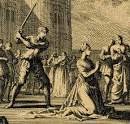
A few events have left a lasting impression on the historical record. The Jesuit Robert Persons founded a College in Saint-Omer 1593, which had as its mission the education of refugee Catholics after the English penal laws were put into place. And it was from Saint-Omer that Henry VIII imported an expert swordsman to insure that the execution of Anne Boleyn would go smoothly.


But things have been relatively quiet in Saint-Omer for the past 200 years or so; that is, until last Saturday. Last Saturday, Eric Rasmussen was in Saint-Omer to verify that a book found in the town library (the Bibliothèque Municipale) was indeed one of the few original First Folio editions of the works of Shakespeare (Mr. William Shakespeares Comedies, Histories, & Tragedies, 1623).


Rasmussen’s qualifications for this task are impeccable: professor and chair of the department of English at the University of Nevada, author (with Anthony James West) of The Shakespeare First Folios: A Descriptive Catalogue (Palgrave Macmillan, 2012), developer of the Internet Shakespeare Project and editor of the RSC Complete Works of Shakespeare series. No wonder it took him less than 5 minutes to determine the authenticity of the book!


The Saint-Omer First Folio was found by the Library staff during a hunt for volumes to be included in an upcoming exhibition of English-language books. It had been catalogued as an 18th century edition of Shakespeare works,”and it was just sitting on a shelf alongside other books by English authors,” the library’s Rare Books librarian Rémy Cordonnier said. The town library retains some of the books originally held by the Abbey of St Bertain, but this is likely from the library of the College of St Omer. The Bibliothèque Municipale also has one of the 48 surviving copies of the Gutenberg Bible, although its copy is incomplete. (Were these deemed not worth moving when the College relocated to England in 1794?)


The newly-discovered Omer First Folio bears the name ‘Nevill,’ a Catholic family name with a rich pedigree in the highly-charged religio-polical world of the 16th and early-17th centuries. It was the Nevilles (along with the Percys) who had been at the center of the Revolt of the Northern Earls in 1569, which aimed to depose the Protestant Elizabeth and to replace her with the Catholic Mary. The revolt ended in disaster, and members of the Neville family fled into exile abroad. Like Shakespeare, the Nevilles had Warwickshire roots, and Warwickshire was known to be a hotbed of Catholic sedition. An Edmund Neville (1605-1647) is known to have been educated at the College. And members of the Scarisbrick family also adopted the alias 'Neville;' Edmund Scarisbrick (1639-1708) was also a student at Saint Omer.

One wonders what the network of spies in Elizabeth’s court, who were always looking for signs of religious treachery and who make the TSA look like rank amateurs, would have made of this First Folio in the collection of renegade Catholic institution? Would Will Shakespeare have had to answer some probing questions? 
"Jean-Christophe Mayer, a Shakespeare expert at the University of Montpellier III, France, cautioned against making too strong a connection, but noted that a library in the northern French town of Douai also owned some early transcripts of Shakespeare’s plays. 'It’s interesting that the plays were on the syllabuses at these colleges,' he said. The new folio, he added, “could be part of the puzzle of Shakespeare’s place in Catholic culture.'”  http://www.nytimes.com/2014/11/26/arts/shakespeare-folio-discovered-in-france-.html?_r=0
We await with interest the further insights of the serious Shakespeare scholars, but in the meantime we rejoice at this remarkable discovery. Check your attics, everyone!


Wednesday, November 19, 2014

The Eyes Have It!

I'm having warm thoughts about ophthalmology these days. My spouse has just had a cataract removed, and over the past several weeks we have seen (and been seen by) more different kinds of eye specialists than I imagined possible. The eye is a remarkable structure, and the science of the eye has a long and rich medical, bibliographical, literary history. But as a focus within the history of Islamic medicine, it has a particular status.


The earliest systematic treatise on the eye is attributed to the Islamic scholar and physician Hunayn ibn Ishaq (809-873), who spent much of his storied career translating Greek and Syriac manuscripts, and thus spreading classical influence throughout the Muslim world. His Ten Treatises on the Eye is not, however, one of these translations, but rather among his works of original medical research. It describes the anatomy of the eye in exquisite detail, and discusses treatments for, among other things, cataracts.


But for nearly a thousand years this treatise was lost, although secondary references to it gave scholars some sense of its contents. The great historian of medicine Julius Hirschberg (1843-1925) discovered a Latin manuscript of The Ten Treatises bound into a collection of works by Galen (c.129-200 or 216), and Orientalist Max Meyerhoff (1874-1945), the preeminent student of Arabic medical literature, discovered a (rather corrupt) Arabic version of the text in the Islamic library of Ahmed Taimur Pasha (1872-1940) in Cairo. It was Meyerhoff who managed to produce a full critical edition by comparing the Cairo text with another more complete manuscript in Leningrad.


Max Meyerhoff

Meyerhoff described the growth of the Muslim study of medicine, launched by those like Hunayn ibn Ishaq who began by translating classical manuscripts:
“At the end of the period of translation, the physicians and scientists of the Islamic world stood on a firm foundation of Greek science, increased by a large share of Persian and Indian thought and experience. Their work had been learned but was not very original. From this time on they begin to rely upon their own resources and develop from within. The sciences, particularly medicine, now pass rapidly from the hands of Christians and Sabians into the possession of Muslim scholars, mostly Persians. In medicine, in place of pandects compiled from antique sources, we find imposing encyclopedic works in which the knowledge of former generations is carefully classified and set against that of modern times.” (Meyerhof, Science and Medicine: The Legacy of Islam, 322)
It was clear to Meyerhoff and others that ophthalmology was a respected profession in medieval Islamic society, which was not the case in Galen's Rome, where the 'occulist' was deemed a second class medical professional. The crafting of precise specialized medical instruments for the study of the eye (described in the Ten Treatises) combined with theoretical experimental work, resulted in rapid innovation in the care of the eye. The treatment of cataracts described by Hunayn was aided by the development of instruments such as the 'injection syringe,' a hollow needle invented in the 11th century by Ammar ibn Ali of Mosul, which made possible the extraction by suction of soft cataracts.

Hunays writes about performing surgery for a cataract:
"Then I operated on him with the hollow needle and extracted the cataract; and he saw immediately and did not need to lie, but slept as he liked. Only I bandaged his eye for seven days. With this needle nobody preceded me. I have done many operations with it in Egypt."
Throughout the Middle Ages, Islamic physicians advanced the knowledge and treatment of eye diseases, and treatises by Averroes, Ali ibn Isa al-Kahhal’, Jibrail Bukhtishu and Ibn al-Nafis provided solid ground for the field of ophthalmology. A splendid account by Cyril Elgood details this period of medical science: http://www.amazon.com/Medical-History-Persia-Eastern-Caliphate/dp/1108015883

A Medical History of Persia

But sadly, most of this Islamic scholarship in the field of ophthalmology (from the Greek ὀφθαλμός = eye) was lost to Western physicians, and as a distinct medical specialty in the West, ophthalmology dates its origins only  from the appointment by St Bartholomew's Hospital of the first eye surgeon in 1727, from the founding of the ophthalmological hospital i London (later Moorfields Eye Hospital ) in 1805, and from the founding of the American Ophthalmological Society in 1864. Ten years earlier, in 1854, Hermann von Helmholtz (1821-1894) had (re)invented the ophthalmoscope making direct observation of the interior of the eye again possible..


Moorfields Eye Hospital


The  continuing quest for the treatment of diseases of the eye and the reduction of blindness is a noble and often-overlooked aspect of Islamic history. And our experience over the past several days of a return to eye heath after a routine outpatient operation is a thing for which we are enormously grateful, grateful to the giants of both Muslim and Western medical practice. But we wonder if the ophthalmological science of the Muslim world had not been ignored (and, in most cases, despised) by the West, if the quality of life of generations of our forebears with eye disease would have been vastly improved.

In his 1995 novel  Ensaio sobre a Cegueira (= Essay on Blindness), Portuguese Nobel Prize winner Jose Saramago (1922-2010) describes an epidemic of blindness that seizes an unnamed city. We follow the characters as their social fabric unravels and as they attempt to create new forms of community. Sight and sightlessness become an extended metaphors for the ability to form human connections, and we observe the anxiety, apathy, violence, and despair that attends the loss of sight. Many of the characters are named by their disability: the boy with the squint, the girl with dark glasses, the man with the eye patch.

And throughout the novel we are called to appreciate, as we ourselves do this week after cataract surgery, the various deep meanings of the phrase "I see."


Thursday, November 13, 2014

All Six Every Year . . .

Someone once asked philosopher Gilbert Ryle (1900-1976) if he ever read novels. "Yes, certainly," he replied. "I read all six every year."

The 'six' to which he referred were, of course, the six novels of Jane Austen: Sense and Sensibility (1811), Pride and Prejudice (1813), Mansfield Park (1814), Emma (1815), Persuasion (1817 posthumously), and Northanger Abbey (1817 posthumously). Although they received relatively few reviews in her lifetime, they soon became fashionable reading for the taste-makers of the day, and by the time of her death had been translated into French, German, and Swedish. Although it was not until the mid-20th century that the academic world acknowledged her as one of the great English novelists, the memoir written by James Edward Austen Leigh published in 1870 gave readers a sense of the personality behind the novels, leading to the burgeoning of cultivated readership which has lasted until the present day.
 James Edward Austen-Leigh

There is also reason to think about Austen on this the 100th anniversary year of the outbreak of the 1914-1918 War. It was Rudyard Kipling (1865-1936) who coined the term 'Janeites' for Austen's admirers. In one of his Great War stories entitled "The Janeites," a secret-society of Austen-lovers recall having taken her books with them into the trenches. And in Kipling's evocative dialect prose, they banter about Austen's stories and characters. This from a soldier named Humberstall, recalling his reading of Emma: "And—oh yes—there was a Miss Bates; just an old maid runnin’ about like a hen with ’er ’ead cut off, an’ her tongue loose at both ends. I’ve got an aunt like ’er. Good as gold—but, you know.’


Kipling also penned a bit of doggerel in her memory:

Jane lies in Winchester—blessed be her shade!
Praise the Lord for making her, and her for all she made!
And while the stones of Winchester, 
      or Milsom Street, remain,
Glory, love, and honour unto England’s Jane!


(You can read "The Janeites" on the website of the Jane Austen Society of North America: http://www.jasna.org/membership/janeites.html )

Since then, Austen in every generation has continued to find new audiences all around the world. A great number of sequels and prequels to the "six novels" have found their way into print, and the most recent crop of Austen films  (graced by such stars as Kiera Knightley, Emma Thompson, Donald Sutherland and Colin Firth) and have increased popular interest in Austen and her work. Even Bollywood has gotten in on the act!


Just a few days ago at Sotheby's London sale-room, a 1st edition of Pride and Prejudice sold for a record price of  £139,250 (that is, $218,898.22). That was 150K times more than its original cost of 90pence in today's money.
http://www.dailymail.co.uk/news/article-1325055/Early-edition-Jane-Austens-Pride-Prejudice-auctioned-140-000.html 

And in case you really want a first edition for yourself (as originally published in in three volumes), you can have one: Jonker's Rare Books in Henley-on-Thames near Oxford has one currently for sale at just $93,392.64: https://www.jonkers.co.uk/authors/detail/authorid/2599

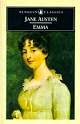
But, for me, I'm happy with my tatty old set of Penguin Classics of Austen, each one read every year for more than a decade. And now that winter is beginning to close in, I'll begin my reading of "all six" for this year with Emma.